
Clarifying Acts
what happens after we experience art

The last time we were together, I told you about the exhibition, This Morning, This Evening, So Soon: James Baldwin and the Voices of Queer Resistance, which I visited back in December. What I didn’t tell you is what happened after I saw the show.
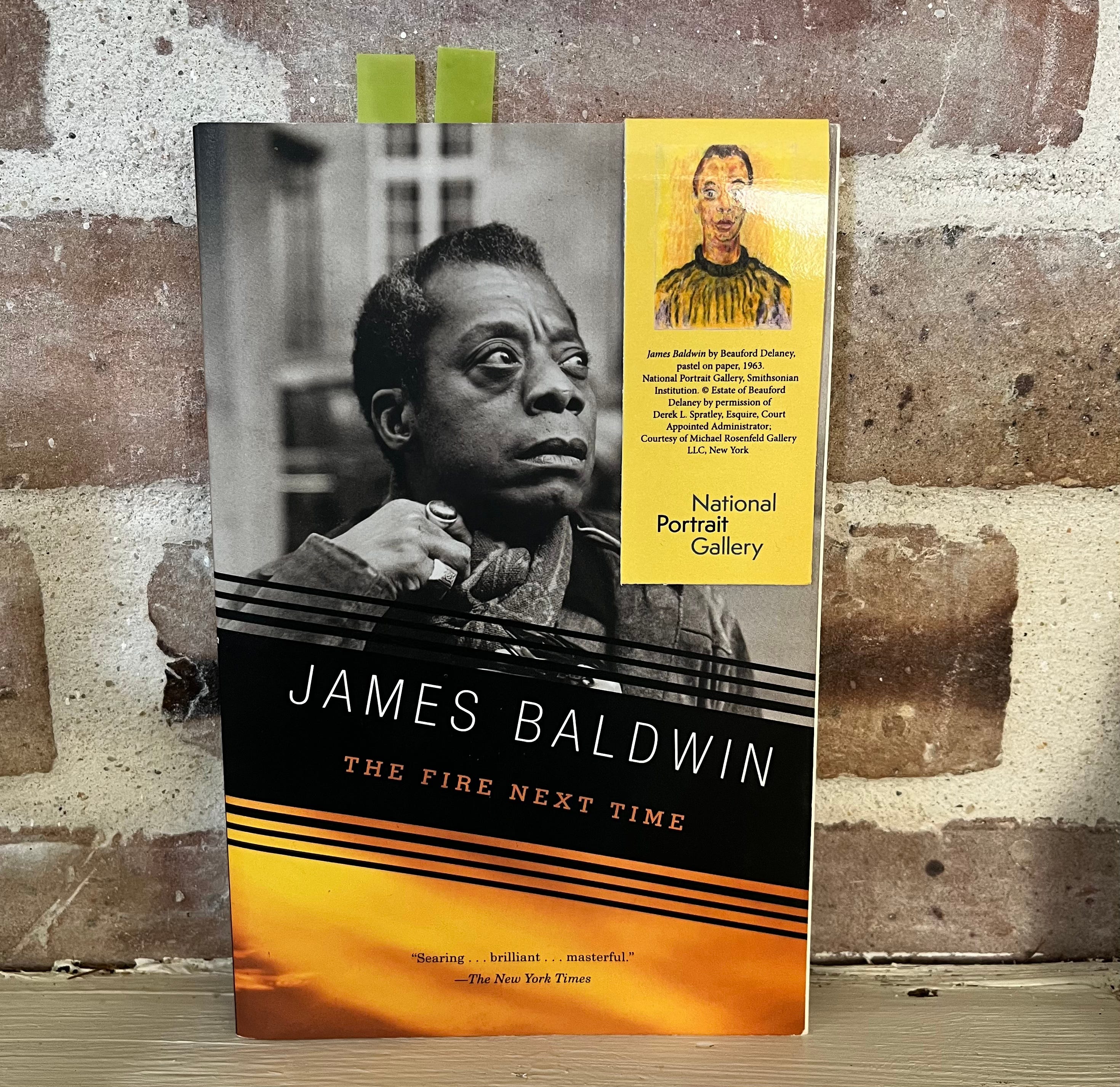
At the end of that Sunday, as I settled into the guest room at Christina’s, I reached into my carry-on and pulled out a copy of James Baldwin’s The Fire Next Time. After going back and forth a few times, I decided to bring the book along for my short trip. I suspected that seeing the exhibition might encourage me to finally finally read the book a guy I used to know gifted me on our first date. My suspicions were correct. I stayed up longer than I intended, reading the two essays styled as letters that make up the seminal text.
This experience of following up This Morning, This Evening with reading The Fire Next Time forced me to confront a blind spot in my analysis of art. My artistic judgments are attached, almost entirely, to feelings. I tend to like the art that engenders feelings I enjoy: nostalgia, curiosity, gratitude, delight, optimism, awe. I have less of an affinity for work that makes me feel confused, tired, hungry, or tricked. I only truly dislike art when I encounter something and feel nothing.
However, prioritizing feelings has obscured another critical response to art for me. As you decide what you think about a work after an initial or early encounter, what that work inspires you to do in the moments after you see it is just as important as how it makes you feel. (By you, I mean me, and by you, I also mean us.) Do you grab for your phone to take a picture or make a video, buy a catalogue, send a postcard, tell a friend, look again, read something related, watch something similar, add to a playlist? Actions can clarify feelings.
An exhibition, like an album, is a work of art consisting of other works of art grouped together by some aesthetic commonality. There are works in This Morning, This Evening that made me feel grateful, curious, and nostalgic, the type of feeling that should automatically slot art into the “like” category. Off the strength of Lorna Simpson, Faith Ringgold, Glenn Ligon, and Beauford Delaney’s contributions, I tried to convince myself that I enjoyed the entire exhibition because I liked parts of it, but that’s like claiming to love an album even though you only listen to the singles.


I didn’t read The Fire Next Time because the exhibition motivated me to expand my engagement with James Baldwin beyond the quotes and video clips perpetually posted on social media and beyond the half-memories I have of reading Notes of a Native Son the summer before college. I read in an attempt to reconcile the parts of the exhibition that felt vague and confusing, to understand the songs I couldn’t get into. I read to avoid feeling disappointed.
Unfortunately reading did not resolve the exhibition’s vague and confusing aspects. In reading I found no answers to the questions sparked by the show like, was part of the exhibition’s goal to portray Baldwin as an activist? Is that why the show included works about Civil Rights protests and the assassination of Martin Luther King Jr? And what exactly was Baldwin’s relationship to queer resistance, and how was that rendered through objects? Was Nina Simone’s album on display because of her friendship with Baldwin? Why didn’t Baldwin’s writing figure more prominently? Were these available objects in need of a narrative or a narrative constructed around available objects?
Having spent time in the world Baldwin created through specific, direct, and lyrical language, I now see the existence of so many unanswered questions as a curatorial rather than a personal problem. The show failed to live up to its subject.
I could tell you that I process art emotions first because of the prominence of water signs in my astrological chart. And that could be true though a more accurate way of understanding it might be that feelings offer me the easiest path to connection. An emotional connection with something establishes a sense of care, and caring about art allows for more logical investigations like figuring out what a work might mean, how it got made, why it looks a certain way. But the easiest path isn’t the only one; attempting to understand art through action felt like exercising a long, atrophied muscle. The soreness was a reminder that oftentimes, a feeling isn’t a final judgment; it’s just a place to start.
The Extras
A chain of action: Hilton Als Edition
As mentioned last time, the writer/critic/curator Hilton Als helped curate This Morning, This Evening, So Soon: James Baldwin and the Voices of Queer Resistance. This isn’t the first time Als has been (partially) responsible for kicking me into some sort of cultural action.
In the 2017 documentary Joan Didion: The Center Will Not Hold, Als talks about Didion’s “elegant words” referring to Sentimental Journeys her essay about the Central Park Jogger case. The day after watching the documentary I read that essay and I recently reread it and discovered that it’s even better than I remembered. It is her most complete work. I highly recommend.
Hilton Als appeared on the Fresh Air podcast earlier this month. Host Tonya Mosley asked about the time he spent with Prince for a piece he wrote. The conversation prompted me to read Als’s 2012 Prince essay I Am Your Conscious, I Am Love. It’s quite the ride.
Speaking of Prince, I keep trying to talk to people about Ezra Edelman’s scrapped documentary. It’s one of the most fascinating albeit heartbreaking cultural stories. A sign o’ of the terrible times. (links are to two different episodes of the Pablo Torre podcast one with Ezra Edelman the director of the never getting released documentary and one with cultural critic Wesley Morris discussing the cut of the doc he and Pablo were lucky enough to watch.) Let me know if you want to chat.
Question For You
Do you have a story about an experience with art inspiring action and an action leading to a new understanding? I’d love to collect a few and share them with the group.
Thanks for reading!
I remember reading “I Am Your Conscience, I Am Love” in that issue of Harper’s years ago and being blown away. 😭 I think I carried the issue around with me for weeks trying to force whoever I ran into to read it. There’s another piece (maybe two?) in “White Girls” that have a similar dreamlike, “is he talking about a real person or a thing that really happened or is this fantasy based on some real figure/acquaintance who bore an uncanny likeness to the celebrity in question?” that struck me in the same way as the Prince essay!
Water sign supremacy! As a Cancer, I, too, always default to how a piece of art makes me feel. I used to think that meant that I didn’t have the sophistication or depth of thought to really understand and appreciate art, so it’s nice to know that my art mentor and guiding light has similar experiences. Also, thank you for saying you were confused about the inclusion of the Nina Simone material. While I always love to get eyes and ears on her, I didn’t quite understand its inclusion in the exhibit, but kept that to myself. Thank you See Level for teaching me new things and helping grow my art engagement confidence!